Your Vote Doesn't Count
Yes it does!
1/25/20262 min read
In a democracy we all sometimes wonder if voting really matters. Out of the 174 million eligible voters, does my vote even matter? It is easy to argue, NO, Your vote does not count. Only in small local elections is an outcome decided by a single vote. However, the weird thing is that if noone voted, one vote could make all the difference in the world. One person clapping at the end of a performance does not mean much to the actors. But if all the other individuals in the audience start clapping, the sound can be deafening and really meaningful to the actors.
Nearly 50% of Americans believe Climate Change is a serious threat (Gallup 2025). They are right!
If just half of those people that understand the seriousness of climate change reduced their emissions by just 10%, these reductions would be equivalent to almost 1.5% of US emissions. This may not seem significant, but it is! Again, each on their own it is nothing but together, impactful.
Background
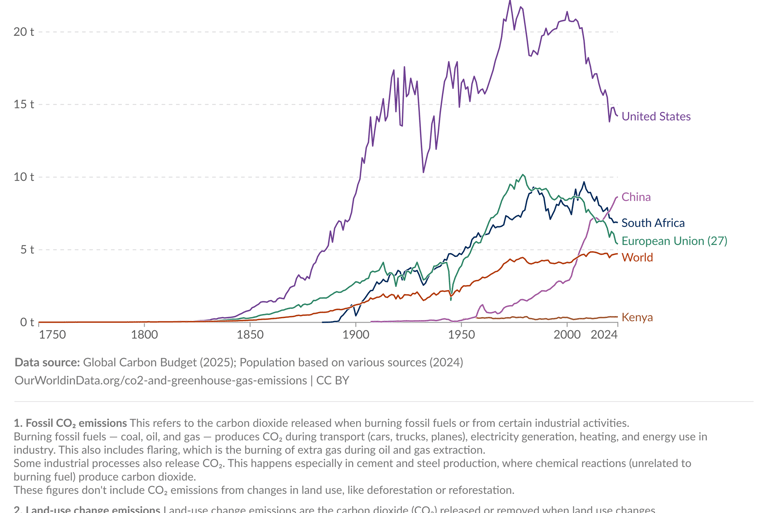
If we divide the total carbon emissions from the US per year by the number of people living in the US we get a per capita emissions of 14,000 kg. (World in Data) This is alot! It is three times the global average and 40 times more than the per capita emissions of people in Kenya.
I don't have alot of data to back me up on this next point, but because we are a strong economy and have a high standard of living we can attribute about 25-30% of the per capita emissions to bridge building, roads, the military, schools, hospitals, and a variety of other services that are beyond our control. This roughly means that individuals have control over about 10,000 kg of emissions per year. (Supporting this 30% value is that consumers make up about 65-70% of GDP in the US.)
This means a 10% emission reduction is about 1000 kg per year per person (3 kg per day). Ninety million people committing to a 1 ton emission is 90 million tons of carbon dioxide! This is a 1.5% reduction in US emissions and equivalent to the emissions from the country of Colombia (World in Data).
But we know that emissions are not evenly distributed among the population with the top 10% of earners responsible for 50% of the US consumption (Marketplace). The wealthy have larger homes, more homes, more vehicles, and generally own more things that require energy and subsequently emit more greenhouse gasses than others. But lets not blame the wealthy, we are all in this together. We just need everyone to to their part.
Will a 10% reduction be a hardship? Possibly, but not likely. As you will learn, simple changes can be made to get to this 10% reduction. If you are buying 10 pairs of shoes a year, buy just 9. If your car is getting 25 mpg, driving more cautiously you can increase your mileage to 27.5 mpg which is a 10% reduction in transportation emissions.
Follow the instructions on this website and make a commitment to reduce your carbon.
Your vote DOES count!