Home Emissions Tracking
Home energy use (electricity and natural gas) is likely your second biggest emission source (following transportation). But you won't know for sure until you find your baseline. (You don't know how fast you run until you time yourself.)
It is also one of the easiest things you can do if you are a home owner or someone that pays your own utility bills. If you don't have access to your utillity bills then you will need to estimate this using a Carbon Calculator.
Yes, finding your homes baseline emissions will take 30 minute or an hour of your time, but the planet is worth it.
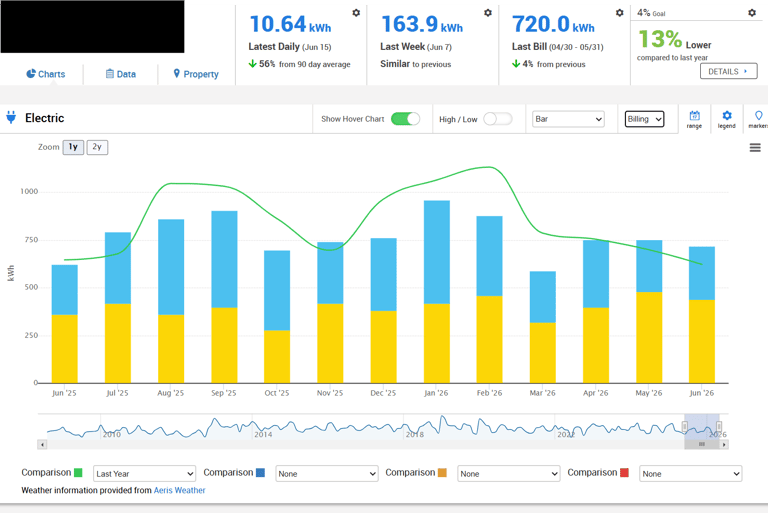
If you are lucky, your utility will provide you with a graph like this. You can see the monthly energy use, combined blue and yellow bars, with last years electricity use, green line. My utility also shows that I am 13% lower this year than last!! No calculations needed.
Electricity Baseline
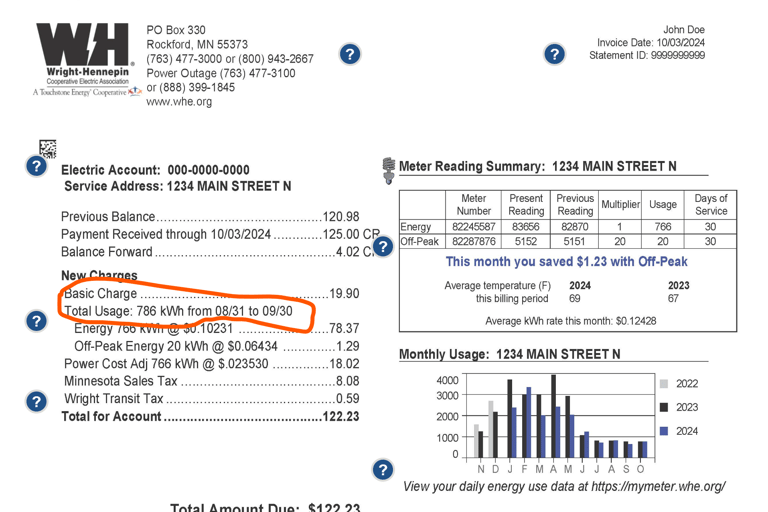
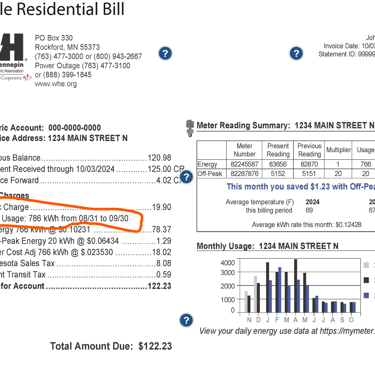
If your utility does not have that handy graph, you will need to take out your calculator and access your monthly bills. To get your annual electric energy use total add up the total kWh per month over the past 12 months. This number is likely to be between 2000 and 30,000 kWh/year.
In 2025, my home used 4600 kWh/year of electricity. Now, if my target emissions reductions is 10% I know I have to reduce my electricity use by 460 kWh/year. If I am successful, my 2026 annual household electricity use would be just 4140 kWh.
To convert this 10% reduction (460 kWh) into emissions I need to multiply by 0.35 kg CO2e/kWh. This means the household electricity emissions are 160 kg/year.
But remember, to get your personal emissions, you need to divide the household emissions by the the number of people living in the home. I live with one other person so I will divide by the home carbon emissions by "2" to get the electrical consumption contribution to my carbon footprint.
161 kg CO2e / 2 year = 80 kg CO2e/year
I can then divide that number by 365 to get my target reduction per day.
80 kg/CO2e/year / 365 days/year = 0.22 kg CO2e/day
*For those of you questioning the 0.346 factor: this is a national average. It is possible to be more accurate but also more complicated so for the purposes of Climate Responsible, we are defaulting to simplification.
Home Natural Gas
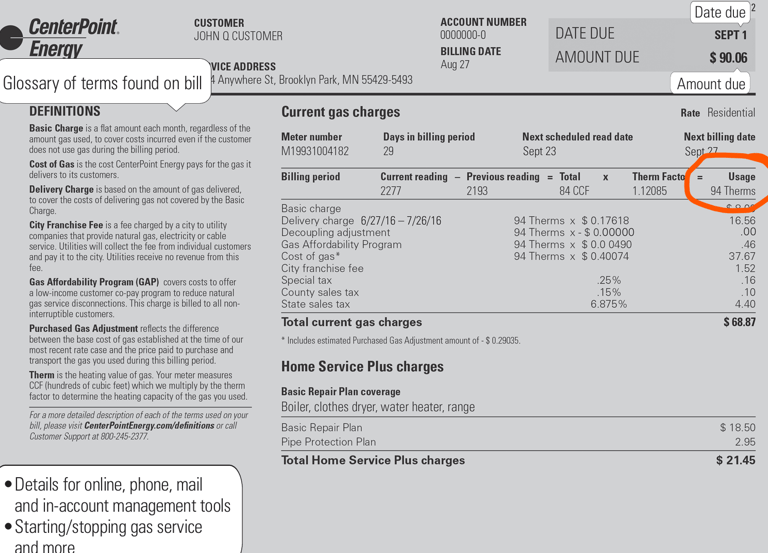
Calculating emissions from natural gas requires knowledge of the therms of natural gas used in a year. This is provided in your monthly gas bill from your utility. This can be accessed through the utilities online portal or by keeping track of your monthly billing statements. Add all the monthly therms for the past 12 months from your billing statements to get the annual therms used.
In my home we use about 370 therms/year. A 10% reduction means our annual natural gas use target would be 333 therms/year, a reduction of 37 therms.
But since I share a home with one other person, I need to divide the therms by 2 so my share of the therms is 37/2 or about 19 therms per year.
Since each therm of natural gas represents 5.3 kg of CO2e, my reduction of 19 therms per year is equivalent to about 100 kg CO2e per year or about 0.27 kg CO2e/day
19 therms/year x 5.3 kg CO2e/therm / 365 days/year = 0.27 kg CO2e/day
Source for kg CO2 factors. EPA Greenhouse Gas Emissions Equivalency Calculator